I wanted to understand a deceptively simple perception problem: can a generic visual embedding find hero portraits or skill icons directly from a complete game screenshot, without being told where those icons are?
This post documents the resulting experiment, including the parts that failed. It is best read as a qualitative case study, not a benchmark. The implementation is real and reproducible, but the evidence comes from only seven temporally correlated frames and has no independent ground-truth annotations.
TL;DR: ConvNeXt-Tiny retrieval can attach a plausible identity to a crop that contains substantial icon content, but it does not localize icons reliably in a full screenshot. The forced-top-three search returns shifted, partial, duplicate, and non-target regions, while the 384 × 384 encoder input is 9.36× slower than the earlier 128 × 128 run. The next experiment should separate proposal quality, identity retrieval on ground-truth crops, and end-to-end detection.
Article map
- Task and evidence boundary
- Candidate-window geometry
- ConvNeXt descriptor construction
- Exact retrieval and region selection
- Qualitative results
- Factorized evaluation
- Reproducibility snapshot
- Next experiments
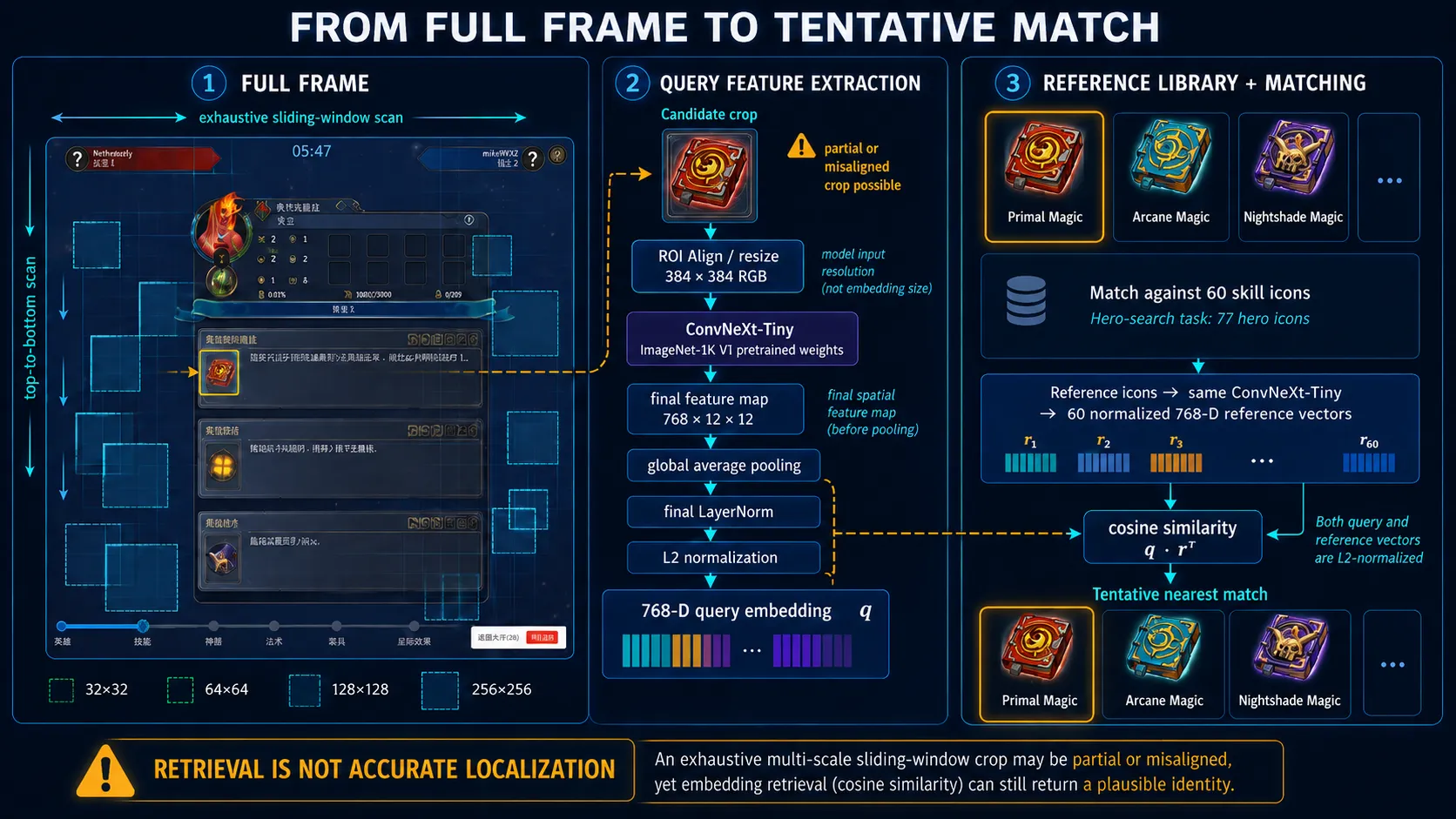
Figure 1. The full pipeline. A plausible nearest identity can still come from a partial or misaligned crop.
The task
At inference time, the input is one complete 1920 × 1078 screenshot. The search is configured for one of two tasks:
| Task | Visible targets | Identity space | Reference images |
|---|---|---|---|
| Hero selection | 3 portraits | 77 heroes | 77 portraits |
| Main-skill selection | 3 icons | 20 skills | 60 level-specific icons |
For every output region, the system returns a bounding box and the three nearest labeled identities.
The experiment displays three hero frames and four skill frames. These are not seven independent test cases. They came from one recording: the hero frames contain essentially the same three identities, and three skill frames are near-duplicates. Repeated behavior across adjacent frames tells us about temporal stability, not generalization across matches, identities, layouts, or recording conditions.
Experiment contract
| Study property | What was actually used |
|---|---|
| Source material | One recording; seven displayed frames |
| Independent sessions | One |
| Ground-truth boxes or labels | None |
| Output rule | Exactly three regions per screenshot, with no reject option |
| Quantitative comparison | Runtime only; 128 × 128 versus 384 × 384 encoder input |
| Defensible interpretation | Qualitative mechanism and failure analysis, not accuracy or generalization |
What the search knows
The experiment deliberately excludes a positional prior. It does not know the icon row, column, slot, or region of interest. It does not use OCR, screen titles, border rules, color heuristics, or an objectness model.
However, “no positional prior” does not mean “no prior.” The search still knows:
- whether it is searching for heroes or main skills;
- a task-specific list of square candidate sizes;
- a fixed stride;
- that exactly three regions must be returned;
- a class-agnostic NMS separation threshold;
- the task-specific labeled reference vocabulary.
That distinction matters. Calling the system “prior-free” or saying box size is its “only spatial prior” would understate how much structure the experiment already assumes.
Candidate geometry
Hero candidates use square source boxes of 128, 144, 160, 176, and 192 pixels with a 20-pixel stride. Main-skill candidates use 72, 84, 96, 108, 120, and 132 pixels with a 16-pixel stride.
Coordinates are integer, half-open boxes [x1, y1, x2, y2), so width is x2 - x1. Regular stride positions are enumerated first. If the stride misses the far edge, one final boundary-aligned position is appended. The configured set is exhaustive, although the last step on an axis may not be uniform.
| Task | Box | Horizontal × vertical positions | Windows |
|---|---|---|---|
| Hero | 128 × 128 | 91 × 49 | 4,459 |
| Hero | 144 × 144 | 90 × 48 | 4,320 |
| Hero | 160 × 160 | 89 × 47 | 4,183 |
| Hero | 176 × 176 | 89 × 47 | 4,183 |
| Hero | 192 × 192 | 88 × 46 | 4,048 |
| Main skill | 72 × 72 | 117 × 64 | 7,488 |
| Main skill | 84 × 84 | 116 × 64 | 7,424 |
| Main skill | 96 × 96 | 115 × 63 | 7,245 |
| Main skill | 108 × 108 | 115 × 62 | 7,130 |
| Main skill | 120 × 120 | 114 × 61 | 6,954 |
| Main skill | 132 × 132 | 113 × 61 | 6,893 |
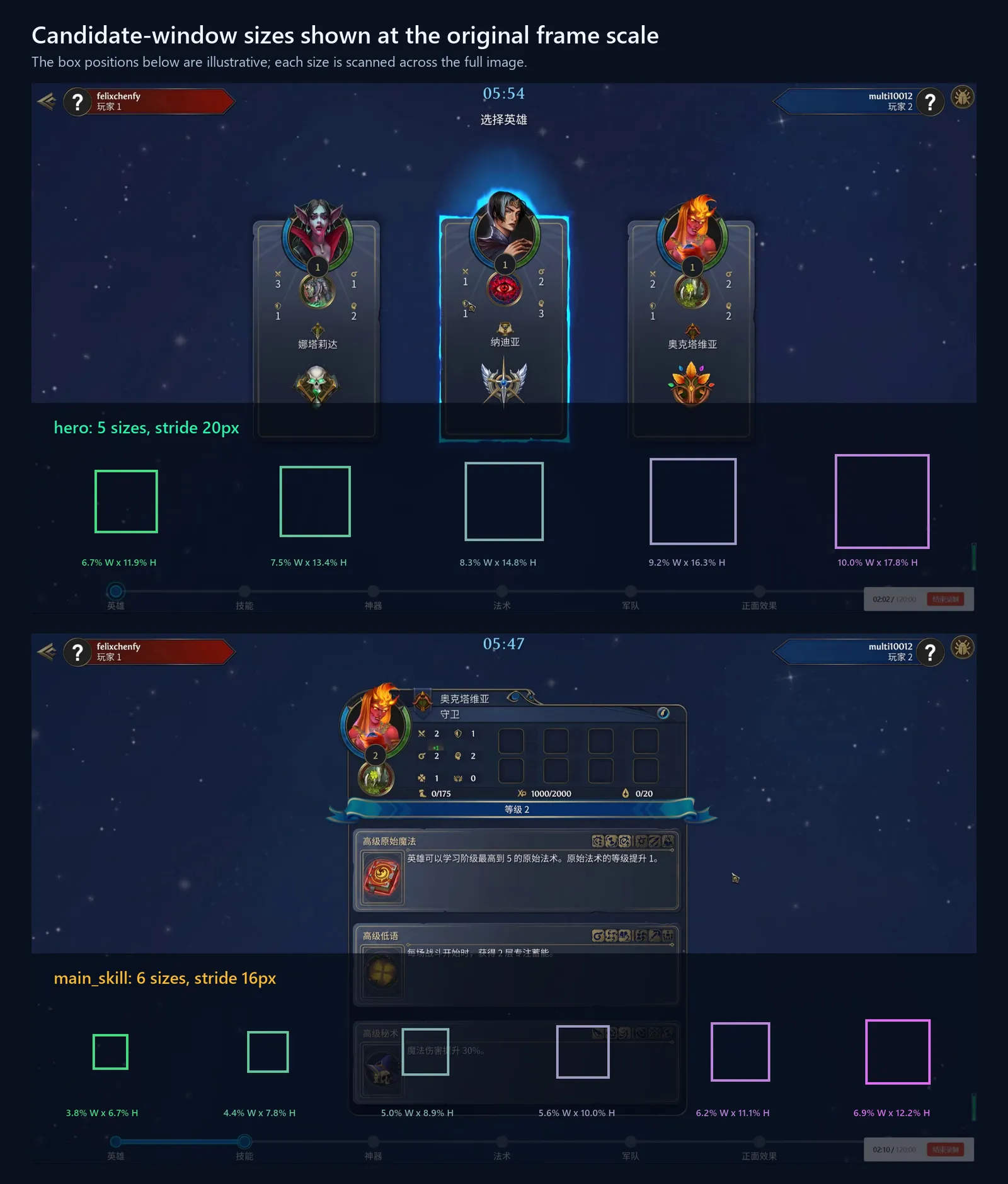
Figure 2. Candidate sizes at their source-frame proportions. The displayed positions are illustrative; every size scans the complete frame.
Before scoring anything, an annotated benchmark should measure the best IoU attainable by this grid for every true icon. That oracle proposal recall would tell us whether square shape, scale range, or stride already imposes a low localization ceiling.
Turning a crop into a visual vector
The encoder is torchvision.models.convnext_tiny with ConvNeXt_Tiny_Weights.IMAGENET1K_V1.
The implementation uses:
- Python 3.12.13;
- PyTorch 2.13.0+cu130;
- torchvision 0.28.0+cu130;
- CUDA 13.0 and cuDNN 9.2;
- an NVIDIA GeForce RTX 5080;
model.eval()andtorch.inference_mode();- FP16 CUDA autocast for convolution and matrix multiplication;
- float32 similarity reduction.
Query pixels are converted to three-channel RGB float values in [0, 1], then normalized with ImageNet mean (0.485, 0.456, 0.406) and standard deviation (0.229, 0.224, 0.225).
Candidate boxes are resampled directly from the float RGB frame with torchvision.ops.roi_align:
output_size = (384, 384)
spatial_scale = 1.0
sampling_ratio = 2
aligned = true
The descriptor path is:
source candidate crop
  → RoI Align to 384 × 384 RGB
  → ConvNeXt feature stages: 96 → 192 → 384 → 768 channels
  → final feature map: 768 × 12 × 12
  → adaptive global average pooling
  → classifier[0] LayerNorm
  → flatten to 768 dimensions
  → L2 normalization
The 1,000 ImageNet logits are not used. The resulting vector is the normalized 768-dimensional pre-logit descriptor.
Reference artwork follows a slightly different resampling path: PIL bicubic resize after alpha compositing. This query/reference operator difference is a possible source of domain mismatch and was not ablated.
What did 384 × 384 actually establish?
An earlier configuration used 128 × 128 encoder inputs and produced a 768 × 4 × 4 final feature map. The displayed configuration uses 384 × 384 and produces 768 × 12 × 12 before pooling.
| Configuration | Batch size | Seven-frame runtime |
|---|---|---|
| 128 × 128 | 256 | 28.33 s |
| 384 × 384 | 64 | 265.25 s |
The 384 configuration was 9.36× slower in these two complete runs. That is the only defensible quantitative conclusion.
This is not a clean resolution ablation because batch size also changed, the canonical 224 × 224 condition is missing, timing was not repeated, and no paired identity or localization annotations exist. Larger absolute cosine scores would not prove better quality anyway; changing input preprocessing can shift the score distribution.
Building the reference vectors
Hero identities have one portrait each. Every main skill has Basic, Advanced, and Expert artwork, giving 60 visual references for 20 skill identities.
Some source artwork contains transparency, while this pretrained ConvNeXt expects three-channel RGB input. Each reference image is:
- cropped to pixels with alpha greater than 8;
- padded by 8% of its longest side;
- composited onto three fixed RGB backgrounds;
- bicubic-resized and ImageNet-normalized;
- encoded into three individually L2-normalized vectors;
- averaged and L2-normalized again.
r(entity, visual variant)
    = normalize(mean(r_dark_blue, r_dark_gray, r_light_gray))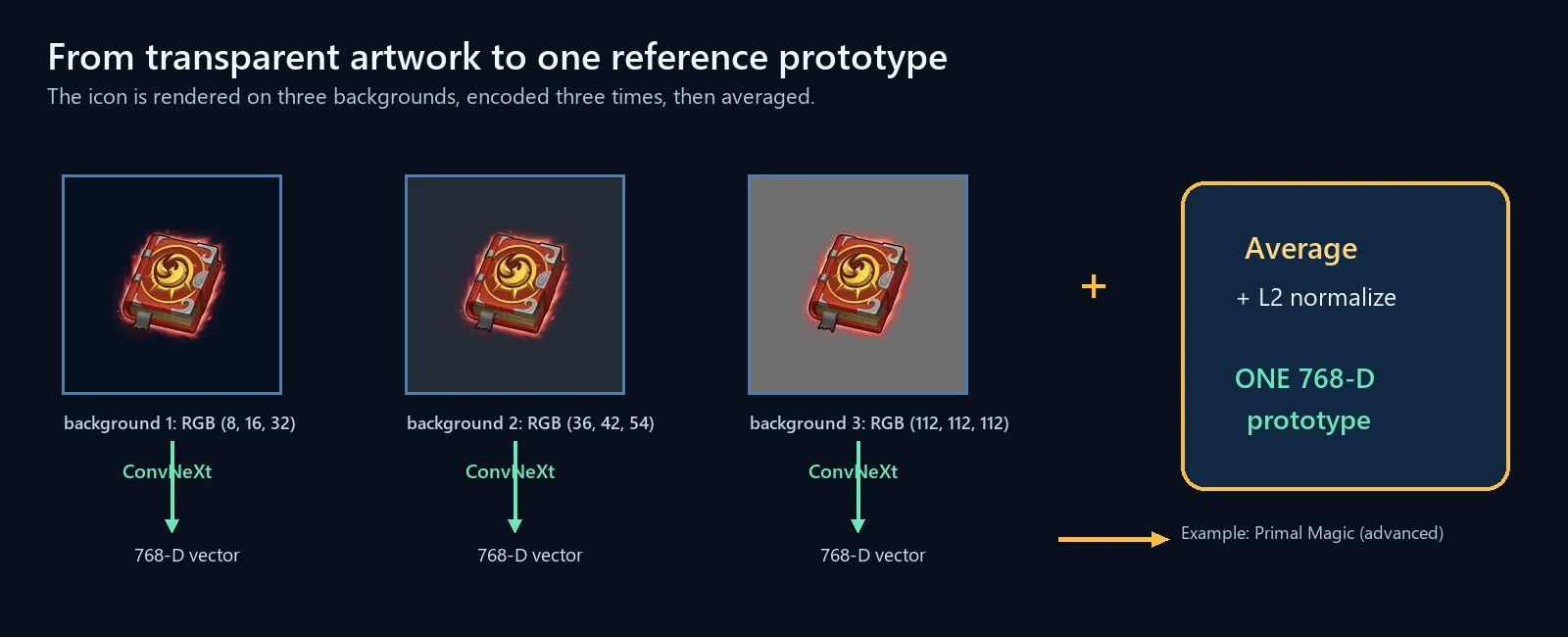
Figure 3. The implemented three-background heuristic. This experiment does not establish that the heuristic improves invariance or accuracy.
Three fixed backgrounds may reduce dependence on one arbitrary fill color, but they may also introduce their own bias. Useful controls would include no compositing augmentation, separate background prototypes, random in-game backgrounds, alpha-aware features, and references cropped from the actual renderer.
Exact cosine retrieval
Let Q contain N normalized candidate descriptors and R contain M normalized reference descriptors. Each row has 768 dimensions.
S = Q Rᵀ
cosine(qᵢ, rⱼ) = qᵢᵀ rⱼ
The dense matrix multiplication compares every candidate with every reference. With only 60 or 77 references, this exhaustive search is simpler than an approximate index such as HNSW or IVF. “Exact” here means no nearest-neighbor approximation; it does not mean exact real-number arithmetic because GPU inference uses FP16 autocast.
The selection algorithm
The reduction from millions of similarities to three displayed regions is where much of the behavior originates:
for every window i:
    per_identity_score[i, c]
        = max similarity over visual references belonging to identity c

    top3_identity_candidates[i]
        = three highest distinct identities

    detection_score[i]
        = top3_identity_candidates[i][0].score

stable-sort every window by detection_score descending

for each window in that order:
    keep it if IoU(window, every kept box) <= 0.10
    stop after exactly three kept regions
Skill levels are collapsed before region selection. NMS is class-agnostic and operates on each window’s top identity score. Identities are distinct within one window’s candidate list, but they are not deduplicated across output regions. Equal scores retain original enumeration order.
The NMS suppression threshold is 0.10. Standard NMS suppresses a lower-scoring proposal only when it overlaps an already retained box by more than that threshold. It does not guarantee one proposal per semantic object.
For example, two displayed skill boxes were approximately:
[672, 464, 756, 548)
[624, 368, 744, 488)
Their IoU is about 0.088. Both survive even though both contain evidence from the same Primal Magic icon. This is NMS behaving as configured, not an implementation error.
The forced-top-three problem
The system has no background class, objectness score, threshold, or reject option. It always returns three regions—even on a screen containing no valid target.
That creates an extreme-value problem. A hero frame tests 21,193 windows against 77 references. A skill frame tests 43,134 windows against 60 references. The largest similarity among millions of comparisons can look impressive simply because so many distractors were tried.
| Task | Frames shown | Windows per frame | Total windows | Exact comparisons |
|---|---|---|---|---|
| Hero | 3 | 21,193 | 63,579 | 4,895,583 |
| Main skill | 4 | 43,134 | 172,536 | 10,352,160 |
| Total | 7 | — | 236,115 | 15,247,743 |
Negative screenshots, unrelated reference libraries, and a calibrated variable-count reject rule are necessary before a maximum cosine can be interpreted as detection evidence. Hero and skill maxima are also not directly comparable because their numbers of windows and reference variants differ.
Representative qualitative outputs
Every panel below comes from the 384 × 384 configuration. I selected three representative panels for readability rather than repeating several adjacent near-duplicate frames. They illustrate behavior; they do not estimate accuracy.
| Panel | Localization | Identity retrieval | What the panel demonstrates |
|---|---|---|---|
| Hero selection (Figure 4) | Mixed: substantial portrait content, but several boxes are shifted | Some top-ranked identities are visually plausible | Retrieval can look useful even when the crop is not a clean object box |
| Repeated skill frame (Figure 5) | Poor: multiple windows survive around one semantic target | The same visual evidence drives several plausible candidates | Low-IoU NMS does not enforce one region per object |
| Distinct skill frame (Figure 6) | Poor: partial and non-target regions remain | A nearest reference is always returned | Forced top-three output is not calibrated detection |
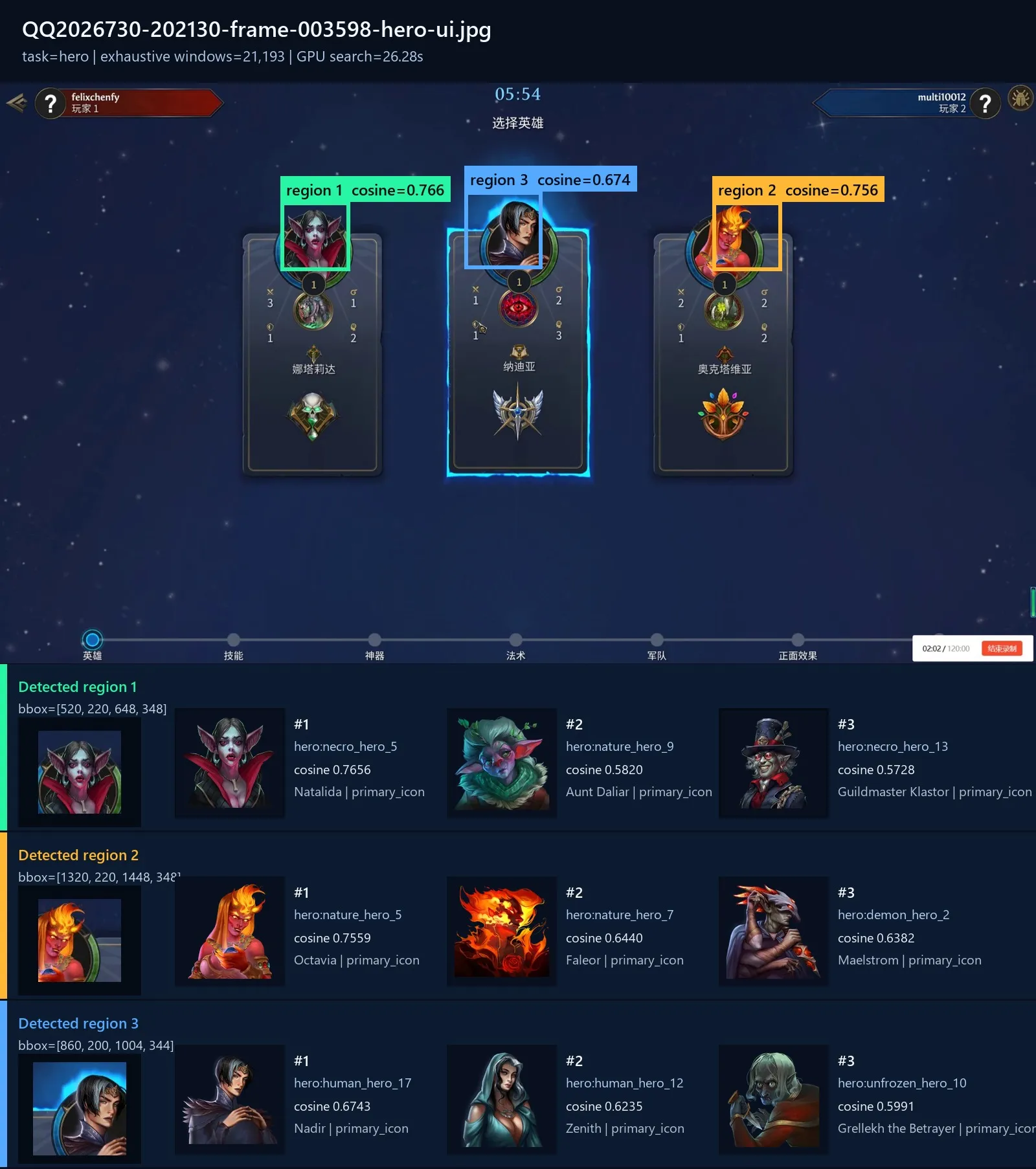
Figure 4. A hero-selection example. Some selected regions contain substantial portrait content, but identity and localization are still scored by the same objective.
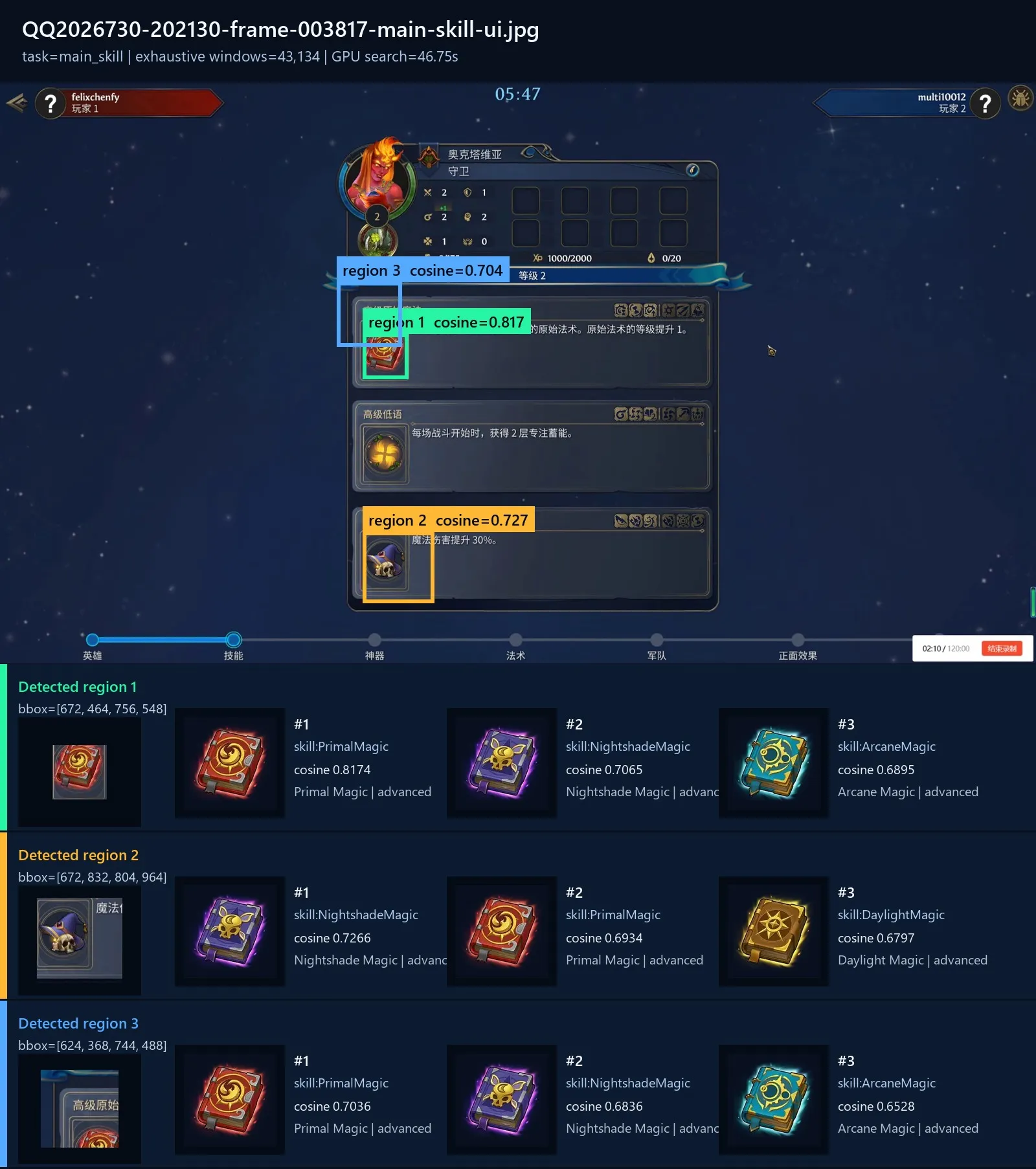
Figure 5. A repeated skill-frame failure mode: partial or shifted windows can survive NMS around one semantic target.
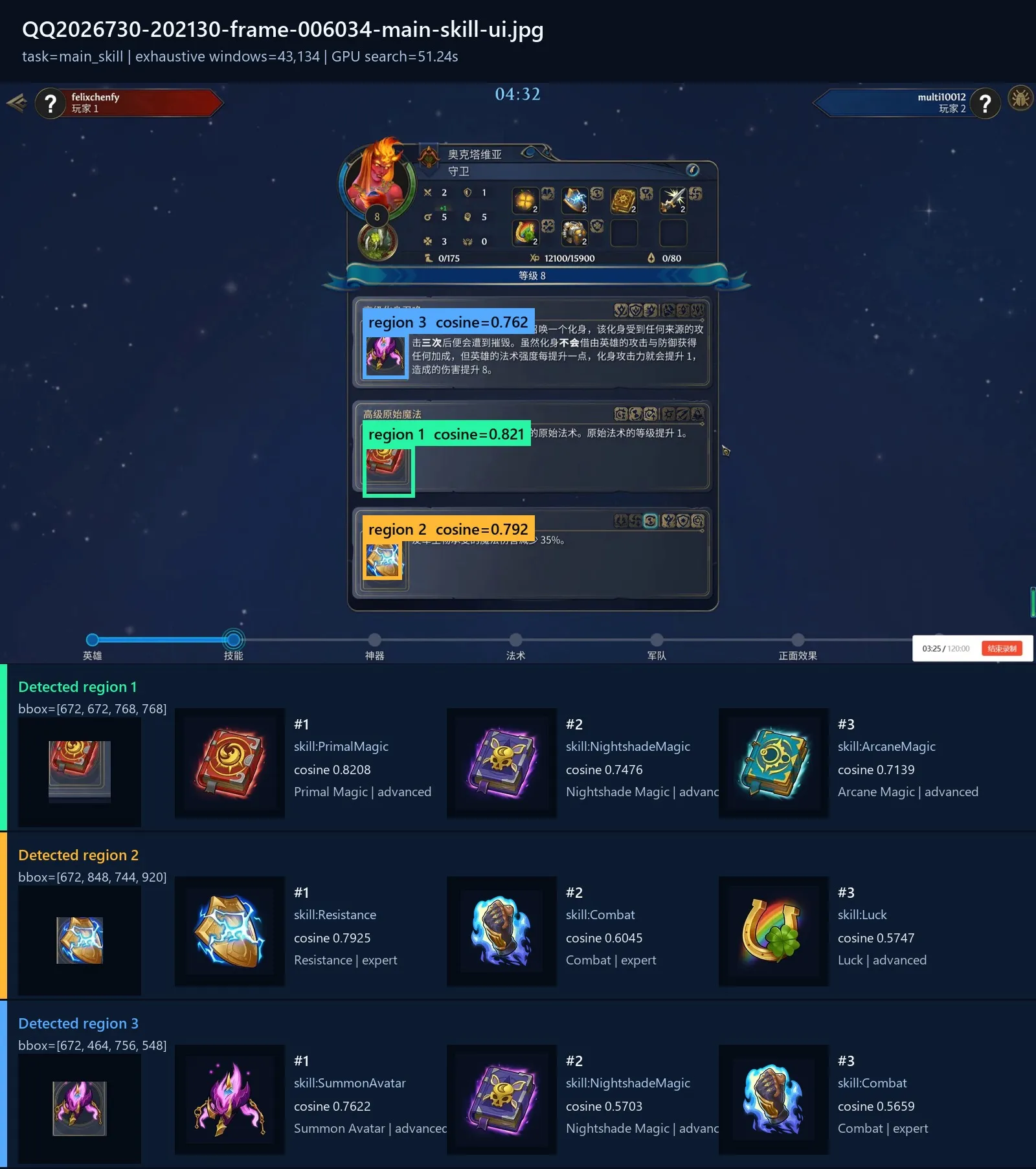
Figure 6. A more distinct skill frame. The scorer still forces three regions and has no way to reject non-target content.
What the examples show
The visible outputs support a modest set of observations:
- some selected crops contain substantial target content and rank a visually corresponding reference first;
- many boxes are shifted, partial, or attached to nearby UI decoration;
- multiple windows can survive around one semantic object;
- the displayed 384 × 384 run still contains obvious localization errors.
They do not establish:
- retrieval reliability across 77 heroes or 20 skills;
- a quality benefit from 384 over 128 or 224;
- a benefit from three-background averaging;
- a benefit from three skill-level references;
- that global pooling or missing objectness is the sole cause of failure.
Identity and localization are coupled
The same cosine score chooses the location and assigns its identity. Identity retrieval is therefore judged only on crops selected by the identity model itself. This makes it impossible to tell whether a failure came from candidate geometry, representation quality, reference mismatch, score aggregation, or NMS.
A fair evaluation should separate three capabilities.
Identity-only
Classify independently annotated, ground-truth crops. Report top-1 and top-3 accuracy, mean reciprocal rank, macro accuracy, and correct-class margin.
Proposal-only
Ignore identity and measure the maximum candidate IoU for every true object. Report proposal recall at IoU 0.25, 0.50, and 0.75, normalized center error, and scale error.
End-to-end
Count a detection as correct only when the identity is correct and IoU exceeds a declared threshold. Report class-aware AP, recall, false positives per image, and the proportion of screenshots where all three targets are found correctly.
The benchmark also needs an operational box definition. “Complete icon” might mean source artwork, the in-game mask, glow, circular frame, or surrounding slot. I would annotate both an inner artwork box and an outer rendered-icon/frame box.
Reproducibility snapshot
This table collects the run-defining choices that are otherwise distributed across the method sections. It is a configuration record, not a public reproduction package: the seven source frames and implementation are not distributed with this post.
| Component | Displayed-run setting |
|---|---|
| Input frame | 1920 × 1078 RGB |
| Encoder | torchvision ConvNeXt-Tiny, IMAGENET1K_V1 weights |
| Descriptor | 768-dimensional pre-logit vector after global average pooling, LayerNorm, and L2 normalization |
| Encoder input | 384 × 384 RoI-aligned crop |
| Hero proposals | 128–192 px square boxes, 20 px stride, 21,193 windows per frame |
| Skill proposals | 72–132 px square boxes, 16 px stride, 43,134 windows per frame |
| Reference bank | 77 hero portraits or 60 level-specific images representing 20 main skills |
| Similarity search | Exact dense cosine matrix multiplication |
| Region reduction | Stable score sort, class-agnostic NMS at IoU 0.10, then exactly three outputs |
| Numeric path | FP16 CUDA autocast for the encoder and matrix multiplication; float32 similarity reduction |
| Hardware | NVIDIA GeForce RTX 5080 |
| Software | Python 3.12.13, PyTorch 2.13.0+cu130, torchvision 0.28.0+cu130, CUDA 13.0, cuDNN 9.2 |
For a faithful rerun, preserve the proposal enumeration order, boundary-aligned final windows, half-open box convention, preprocessing constants, reference compositing policy, and stable tie behavior. Changing any of these can alter the selected regions even when the model weights remain fixed.
The next three experiments
1. Annotated factorization benchmark
Collect roughly 200–300 de-duplicated screenshots from at least 20 independent sessions, plus at least 50 visually similar negative screens. Split by session, not by frame. Annotate identity, skill level, inner and outer boxes, tooltip or occlusion state, and source session.
Freeze the current grid and post-processing on a development split, then measure oracle proposal coverage, oracle-crop identity retrieval, selected proposals, and end-to-end detection separately.
2. Resolution × crop-quality study
Generate controlled translations, scale errors, truncations, and IoU bins from annotated targets. Compare 128, canonical 224, and 384 with the same preprocessing, crop operator, and proposal set.
Report accuracy versus crop IoU, correct-class margin, negative separation, repeated synchronized latency, throughput, and peak VRAM. This would test whether higher encoder resolution actually improves robustness rather than merely shifting cosine values.
3. Proposal/objectness stage with strong baselines
Compare the current scorer against:
- alpha-aware multiscale NCC or edge template matching;
- oracle-grid proposals;
- a fixed ROI or slot-layout baseline;
- screenshot-derived references;
- a lightweight icon-objectness detector;
- detector proposals followed by the unchanged ConvNeXt retriever.
If detector proposals improve results while the retriever stays fixed, that would support the hypothesis that proposal generation is the main bottleneck. If a masked template matcher wins, generic ImageNet embeddings may simply be the wrong representation for this rendering domain.
Conclusion
On this small set of temporally correlated UI frames, nearest-neighbor ConvNeXt features sometimes rank a visually corresponding reference first when the selected crop contains substantial target content. The exhaustive forced-top-three scorer also produces obvious partial crops, duplicates, and non-target regions.
Because there is no independent ground-truth set or paired quality metric, the effects of input resolution, reference augmentation, grid density, and NMS cannot yet be quantified. The 384 × 384 configuration was 9.36× slower than the 128 × 128 configuration in this implementation.
The most useful next step is not another visual tweak. It is an annotated evaluation that separately measures proposal coverage, identity retrieval on oracle crops, and end-to-end detection.
That decomposition would turn this educational failure analysis into an actual perception benchmark.
Comments